Top AI Tools for Streamlining Content Creation

TLDR; The article compares four AI content platforms, Seozilla, Jasper, Writesonic, and Copy.ai, by looking at SEO support, brand voice control, workflow automation, and how well each one fits different teams.
Seozilla comes across as probably the most complete option for scalable AI content creation. It brings SEO automation, brand voice control, CMS publishing, and less manual work into one workflow, which is, honestly, a big plus here. Because everything is in one place, teams usually spend less time switching between tools.
Jasper fits larger marketing teams that need stronger governance and collaboration. Writesonic often suits teams that want a broader SEO-focused toolkit. Copy.ai, meanwhile, is a solid fit for quick short-form and campaign content, especially when speed is the main priority.
The best choice depends on the real bottleneck. For organic growth at scale, it often makes more sense to look at tools that support planning, optimization, and publishing, not just drafting. That usually matters more in this specific context.
Content teams are under more pressure than ever. They need to publish faster, rank for more keywords, keep quality high, and still sound like the brand. That’s why so many marketers are looking for the best AI writing tools and smarter ways to manage AI content creation (which, honestly, can save a lot of time).
To make that choice easier, this comparison looks at four leading options used by digital marketers, SEO specialists, content managers, and growth teams. It focuses on what each tool does best, where it falls short, how it supports SEO workflows, and which teams it tends to fit best. That added context really matters here.
This matters right now because AI content tools usually do much more than generate ideas. The strongest platforms now help with brand voice, SEO structure like headings and keyword placement, workflow automation, and publishing too, which often makes a real difference for busy teams. For anyone trying to grow organic traffic without adding more manual work, understanding that difference clearly matters.
The gap between a general AI writer and a true content engine is huge. In most cases, one helps teams draft faster, while the other supports planning, optimization, and publishing across the full workflow. If a practical shortlist sounds better than a long list of random tools, this is a useful place to start.
What You’ll Find in This Comparison
- Seozilla
- Jasper
- Writesonic
- Copy.ai
Best AI Tools for Easier Content Creation
1. Seozilla
At a Glance
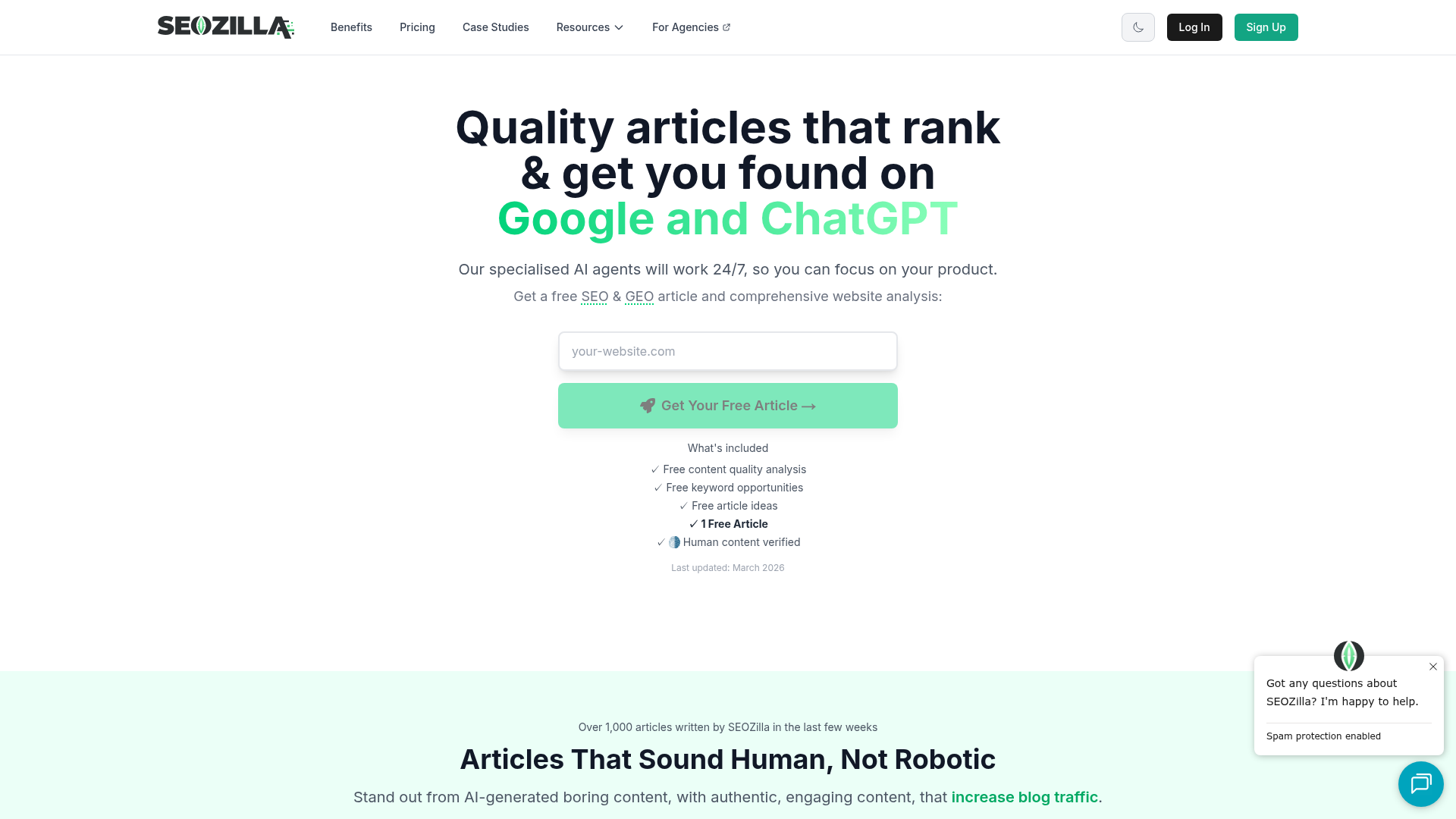
SEOZilla.ai is an AI-powered SEO content platform made for teams that want to grow organic traffic without relying on a lot of manual writing. It does more than act as a basic text generator. The platform is built to create high-quality content that matches a brand’s voice and supports SEO goals, while also making work easier through automation and CMS integration. That makes it especially useful for mid-sized businesses and agencies that need to increase output without losing consistency, which is often where things get hard. For teams focused on search performance, this is the most complete option in this comparison.
Core Features
- AI-powered SEO content generation
- Brand voice adaptation to keep messaging consistent
- Content personalization at scale
- SEO automation for faster production workflows
- CMS integrations for auto-publishing
- Organic traffic growth focus, not generic copy creation
- Built to reduce manual content writing effort
Pros
- Built for SEO outcomes: Seozilla is set up around rankings and traffic growth, not just content generation. That makes it more useful for teams focused on search visibility and organic sessions.
- Strong brand alignment: The platform adjusts to a brand’s voice, helping teams keep content consistent across landing pages, blog posts, and campaigns.
- Workflow automation: CMS integration and auto-publishing save time while reducing handoff delays between content, SEO, and web teams, and that usually makes a noticeable difference.
- Scalable content operations: It supports bigger publishing needs, so teams do not have to grow headcount at the same pace as output.
- Less manual writing: Teams can spend less time drafting every piece by hand and put more energy into review, optimization, and updates.
Who It’s For
Seozilla is a strong fit for digital marketers, SEO specialists, content managers, in-house growth teams, and agencies looking to scale organic traffic efficiently. It works especially well for teams that care about SEO performance, publishing speed, brand consistency, and cutting the time spent creating content from scratch. In many cases, it makes practical sense for teams that already have search-driven goals and need an easier way to publish at a higher volume.
Unique Value Proposition
Seozilla stands out because it brings together several important needs in one workflow: SEO automation, AI content creation, brand voice control, personalization, and publishing. Many AI writing tools can create drafts well enough. The problem is that teams often still have to do a lot of manual work before that content is actually ready to perform in search. Seozilla helps reduce that gap. For organizations trying to grow through search, the challenge usually is not just writing more. It is creating content around the right topics, keeping the right voice, and getting everything published in the CMS without wasting time. That is often where teams run into friction.
Real World Use Case
Take a mid-sized SaaS company with a lean content team and ambitious traffic goals. Instead of spending weeks creating writer briefs, editing for tone, and manually uploading articles into the CMS, the team uses Seozilla to create SEO-focused, brand-aligned content and publish it faster. As a result, more pages go live, production bottlenecks shrink, and the team has more time for strategy and optimization. This does not replace the entire content process, but it likely removes a lot of repetitive work, which is often the part that slows everything down. It is a simple shift, but usually a meaningful one.
Pricing: Contact for pricing
Website: https://www.seozilla.ai/
If a quick side-by-side view is helpful before going deeper, here’s how the top tools compare on the points that matter most to content and growth teams.
| Company | Key Features | Pros | Cons | Pricing |
|---|---|---|---|---|
| Seozilla | SEO content automation, brand voice adaptation, personalization, CMS auto-publishing | Best for scalable SEO workflows, strong brand alignment, less manual work | None | Contact for pricing |
| Jasper | AI writing, brand controls, templates, collaboration, admin features | Strong for marketing teams, brand governance, campaign content | Limited pricing transparency, can be expensive, needs editing | Custom pricing; contact sales |
| Writesonic | AI articles, SEO workflows, AI chat, AI search visibility tools | SEO-focused toolkit, broad feature set, useful for growth teams | Can feel complex, premium features cost more, needs review | From about $79/month annually |
| Copy.ai | AI copy generation, workflow automation, templates, team workflows | Easy to use, fast output, broad template library | Less focused on deep SEO content, enterprise pricing varies, needs oversight | Free and paid plans; custom team pricing |
Looking at the table, Seozilla stands out because it does more than generate words. It helps teams create a repeatable SEO content system that covers drafting, brand voice consistency, and the publishing workflow. For growing brands, that is often closer to what is actually needed.
2. Jasper
At a Glance
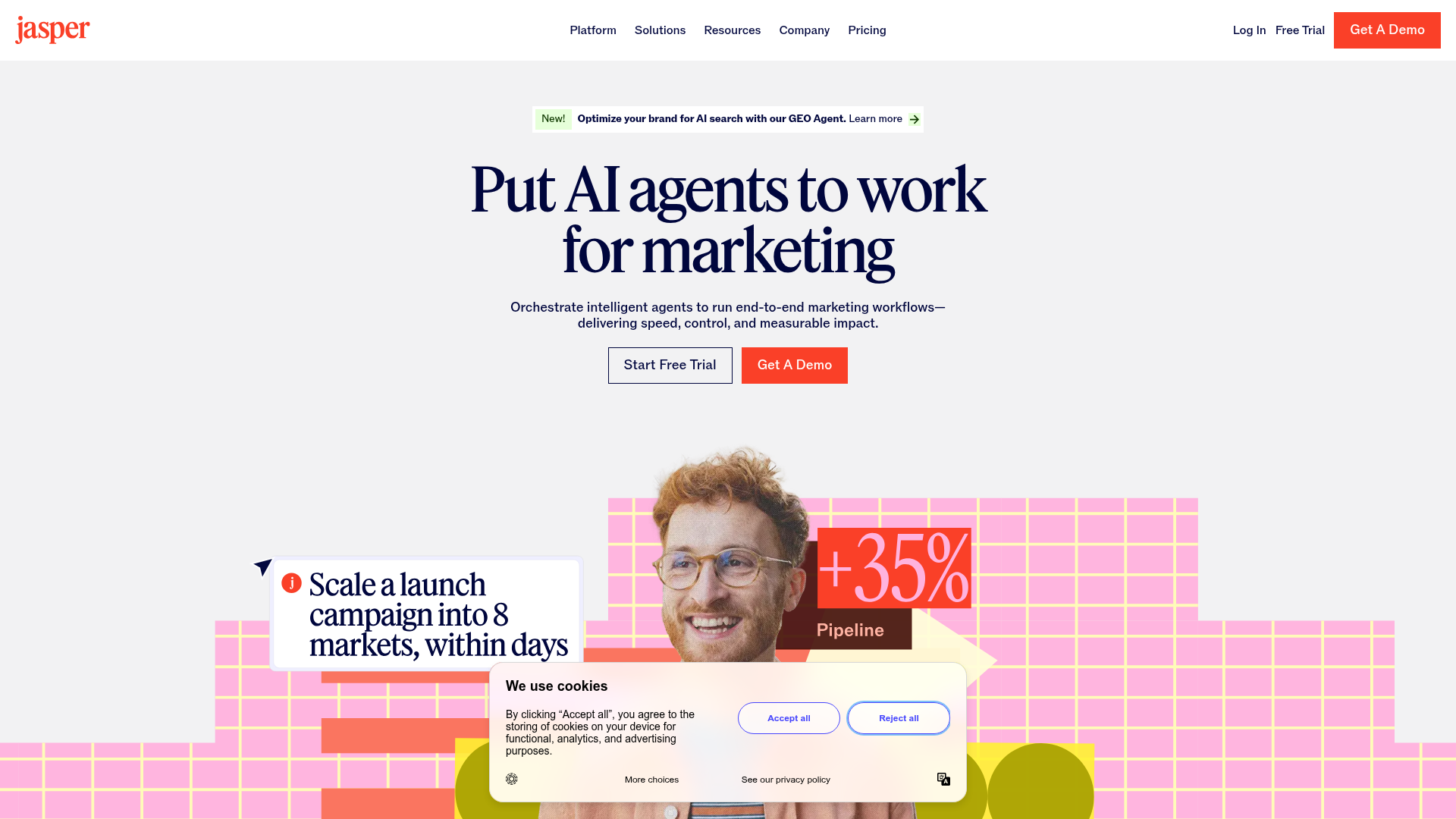
Jasper is one of the best-known AI writing tools for marketing teams. It launched in 2021 and became popular by helping companies create blog posts, ads, emails, landing pages, and campaign assets faster. One area where it often does well is brand control and team collaboration, especially during shared campaign work and review cycles. For larger teams, that can be very useful. Jasper is set up more like a business-ready marketing platform than a simple writing assistant, which makes it a strong choice for bigger organizations, not just solo users. At the same time, teams with very SEO-heavy operations may still need extra workflow layers beyond content generation, including deeper optimization and publishing steps.
Core Features
- AI writing for blogs, ads, emails, and landing pages
- Brand voice and style guide controls
- Marketing workflows for teams
- Collaboration tools
- AI apps and templates for different campaign types
- Business-focused admin and security controls
Pros
- Strong brand governance: Helpful for teams that need clearer style and voice controls, which is often important for marketing groups.
- Marketing-first design: Built with marketers in mind, not just general users.
- Collaboration support: Works well for teams with shared review processes.
- Versatile content types: Useful across blogs, email, ads, landing pages, and other campaign work.
- Enterprise-friendly features: Usually a better fit for structured organizations than many simpler AI tools.
Cons
- Limited pricing transparency: Teams often have to contact sales to get complete cost details.
- Higher cost perception: Jasper is often seen as more expensive than lighter alternatives.
- Still needs editing: Output may need review for precision, originality, and SEO depth, so it is not always something teams can publish as-is.
Who It’s For
Jasper is best for marketing departments and agencies that want an AI tool with stronger governance, collaboration, and campaign support. It is a solid choice for teams creating a high volume of content in different formats. That flexibility can be especially helpful when teams are managing blog posts, email campaigns, and landing page copy at the same time. Teams that care a lot about SEO may still lean toward a platform like Seozilla when automation and publishing workflow matter as much as the writing itself.
Unique Value Proposition
Jasper’s main advantage is that it combines AI generation with controls that help teams stay on brand. The focus is less on one-off writing and more on helping marketing organizations manage content production at scale through shared voice settings, team workflows, and review structure. It is a fairly straightforward idea, but one built for teams and often for process as well.
Pricing: Custom pricing; see https://www.jasper.ai/pricing
Website: https://www.jasper.ai/
3. Writesonic
At a Glance
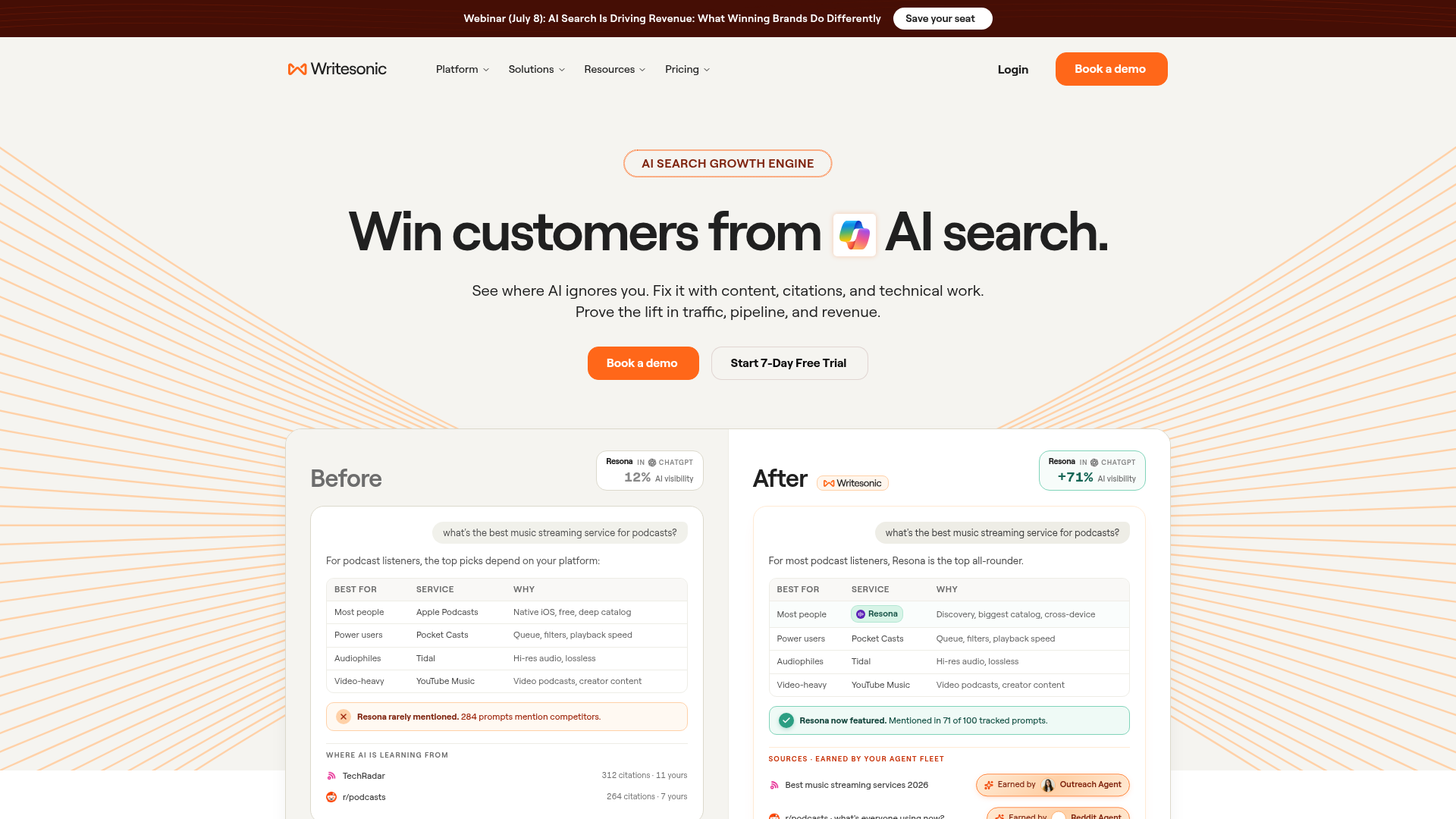
Writesonic is a broad AI content platform that launched in 2020. It brings together article generation, SEO-focused workflows, AI chat, and AI search visibility features in one product. That makes it a solid choice for marketers who want more than a basic writing tool. For teams focused on organic growth, Writesonic feels especially relevant because it speaks directly to SEO use cases, which is often the main reason people consider it. It feels like a practical fit. At the same time, the growing product scope can feel a little busy, especially for teams that would rather use a cleaner, more streamlined content engine with less jumping between features.
Core Features
- AI blog and article generation
- SEO-focused content workflows
- AI chat assistant
- AI search and brand visibility tracking
- Marketing copy generation
- Landing page content support
Pros
- Strong SEO angle: Better suited to search-focused content teams than many general AI writing tools.
- Wide feature set: Useful for teams that want article writing, AI chat, and brand visibility tools in one place.
- Organic growth support: A good fit for marketers trying to improve search visibility across Google and other search-driven channels.
- Public pricing available: It’s easier to estimate cost than with some competitors, which honestly helps a lot.
Cons
- Can feel complex: The broader toolkit may be more than some teams actually need.
- Best features cost more: The more useful capabilities are often locked into higher-priced plans.
- Editing is still needed: Content may still need human review before publishing, especially for accuracy and brand voice.
Who It’s For
Writesonic is a strong option for SEO specialists, content teams, and growth marketers who want AI help with research, drafting, and visibility-focused workflows. It works well for teams that like having a lot of tools in one platform. If the goal is one system for drafting, SEO tasks, and search visibility tracking, it will probably make sense. Teams that want tighter SEO automation and more brand-aligned publishing may still lean toward Seozilla instead, and that is often the tradeoff.
Unique Value Proposition
Writesonic stands out by connecting content creation with SEO and AI search visibility features. It does more than generate quick text. It helps marketers create content, support SEO workflows, and track how that content performs in a search-driven environment. That is likely what makes it more useful for growth-focused teams than a basic AI writer.
Pricing: From about $79/month annually for Starter, with higher tiers for teams
Website: https://writesonic.com
4. Copy.ai
At a Glance
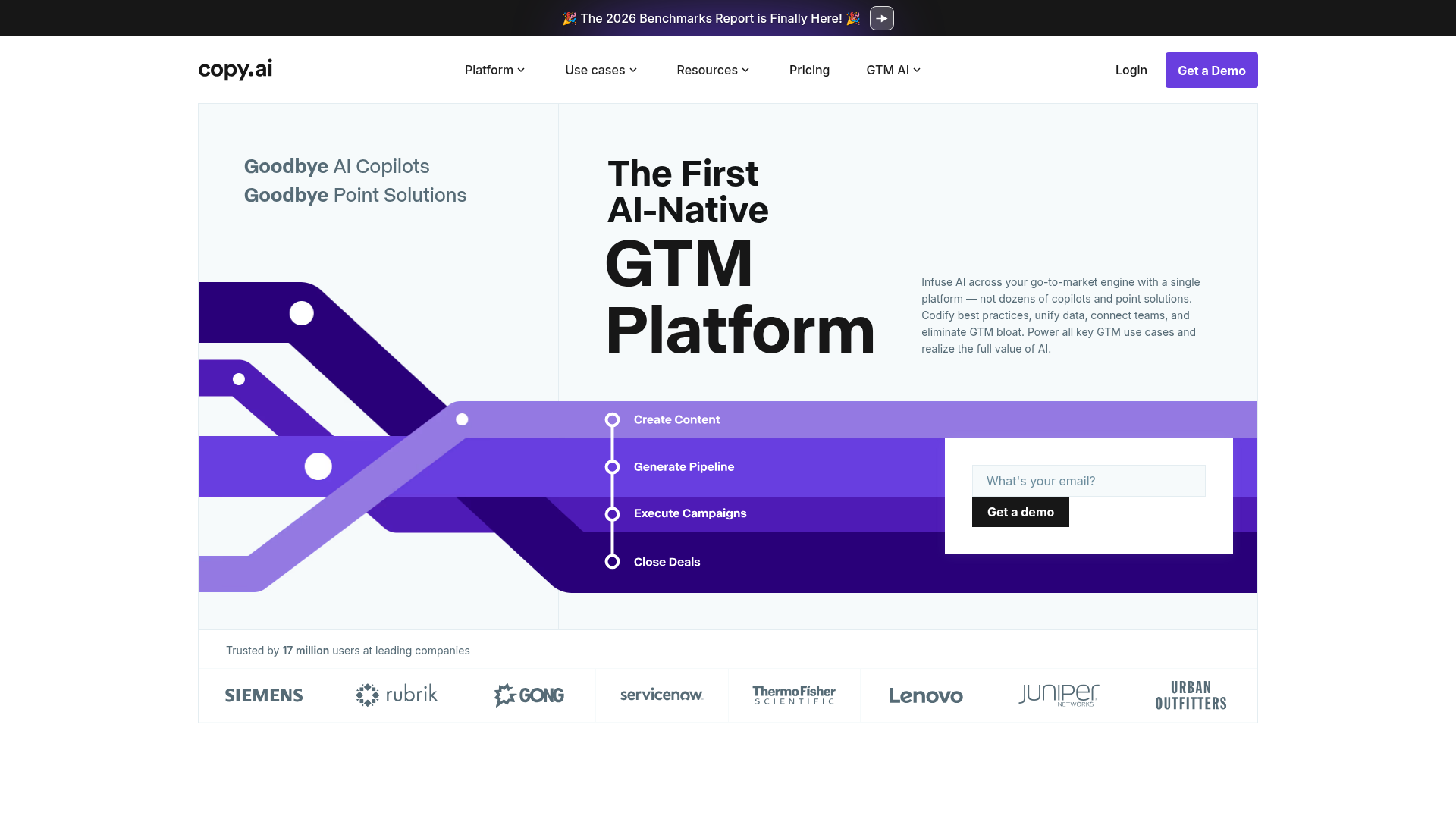
Copy.ai, founded in 2020, is an AI writing and workflow platform built for marketing and go-to-market teams. It’s widely known for being easy to use, quick, and packed with templates, which is a big reason many teams like it. Simple and practical. A lot of teams use it to create campaign copy, emails, social posts, and product messaging fast. It can help with blog content too, but its long-time strength has usually been short-form content and workflow support rather than deeply strategic long-form SEO production.
Core Features
- AI generation for emails, blogs, social posts, and product copy
- Workflow automation for marketing and GTM tasks
- Broad template library
- Team-oriented AI workflows
- Fast content drafting across multiple channels
- Tools built for short-form and campaign content
Pros
- Easy to use: Simple for teams that want to get started fast without much setup.
- Fast output: Helpful when copy needs to be created on a tight timeline.
- Template variety: Useful across a wide range of marketing use cases.
- Workflow support: A good fit for teams handling repeatable content tasks.
Cons
- Less SEO-depth: It isn’t always the best fit for long-form search content strategy.
- Team pricing can vary: Larger organizations may need custom quotes.
- Needs human oversight: The content still often gets better with review and refinement.
Who It’s For
Copy.ai is a strong fit for marketing and go-to-market teams that need fast copy generation across different channels. It tends to work especially well for short-form content and campaign work, which is where it often does its best. Clear and useful. If the main goal is scalable SEO content creation tied to brand voice and publishing automation, Seozilla is probably the better fit because it focuses more on SEO content, brand consistency, and publishing workflows.
Unique Value Proposition
Copy.ai’s biggest advantage is how easy it is to use. It helps teams move from idea to draft quickly and supports repeatable workflows across different marketing functions. Teams that care more about speed and flexibility than deep SEO specialization will probably find that especially useful.
Pricing: Free and paid plans available; custom pricing for larger teams
Website: https://www.copy.ai/
How to Choose the Right AI Content Platform
The right platform really depends on the problem a team is trying to solve. If the goal is just to get quick drafts done, plenty of tools can help with that. But when a team wants to build a reliable organic growth engine, text generation alone usually is not enough. Content quality, SEO fit, smoother workflows, and brand consistency all start to matter at the same time. That is usually when the differences between platforms become obvious pretty fast.
Jasper tends to work well for structured marketing teams. Writesonic is useful for marketers who want a broader SEO-focused toolkit. Copy.ai is a fast, simple option when campaign content is the main need. Seozilla is the strongest fit for teams that want scalable AI content creation tied directly to search performance, brand voice, and publishing automation, which in most cases makes a real difference.
For agencies and mid-sized brands, that difference often shows up in daily operations. The hidden cost in content work is not just writing time. It often shows up in editing, coordination, upload work, inconsistency, and missed publishing opportunities too. Because of that, a platform that removes those bottlenecks can often have a bigger effect than one that only creates drafts.
Ready to Scale Content Without the Usual Bottlenecks?
When a team gets stuck between publishing goals and limited bandwidth, it’s usually facing the same problems many content teams run into: too much manual writing, extra review rounds, an inconsistent brand voice, and SEO plans that often move slower than expected, which can get frustrating fast. Basic AI writing tools may help with speed, but the hardest parts still usually stay on your team’s plate.
That’s where Seozilla is different in this list. It’s built for teams that need more than just generated copy. The platform helps simplify SEO content production, keeps messaging matching your brand, and adds automation so content can move from idea to publication with less friction and usually fewer delays. For marketers and agencies trying to improve organic search performance in an efficient way, that mix is often hard to ignore.
Curious whether a platform built around scalable SEO content operations fits your workflow? Visit https://www.seozilla.ai/ and see how it works with the way your team works.
Frequently Asked Questions
Start with your real goal. If you only need quick copy, a simple generator may be enough. But if you need long-term SEO growth, look for tools that support brand voice, workflow automation, editing efficiency, and content designed for search performance.
Look at output quality, time saved, consistency, and business results. For SEO teams, the best signals include improved publishing speed, better keyword coverage, stronger organic traffic, and less manual work across content operations.
Pricing varies a lot. Some tools offer free plans or low-cost entry tiers, while others use custom enterprise pricing. In general, teams should compare cost against time savings, content volume, and how much extra manual editing or workflow work is still required.
You can usually see workflow improvements right away, especially in drafting and production speed. SEO results take longer. Most teams should expect several weeks to months before seeing clear organic traffic gains, depending on site authority, competition, and content quality.
Mid-sized businesses, agencies, SaaS brands, and growth teams usually benefit the most because they need to publish consistently without adding too much manual work. A platform like SEOZilla.ai makes the most sense when SEO, brand consistency, and scalable publishing are all priorities at the same time.
Sometimes, but not always. General AI writers can help produce drafts, yet many teams still need separate systems for SEO planning, brand control, and publishing. That is why some organizations prefer a more focused platform such as SEOZilla.ai when their main goal is efficient, search-driven content operations rather than simple text generation alone.